

Notes on Viardot: A Texas Opera Premiere Celebrating One of Music’s Forgotten Geniuses
On Friday, November 7 at 7:30 p.m. in Jones Theater, the Baylor Opera Theatre and the Baylor Symphony Orchestra bring to life the Texas premiere of Michael Ching’s Notes on Viardot, a dazzling new opera that restores the legacy of 19th-century icon Pauline Viardot, once hailed by Franz Liszt as “a woman composer of genius.”
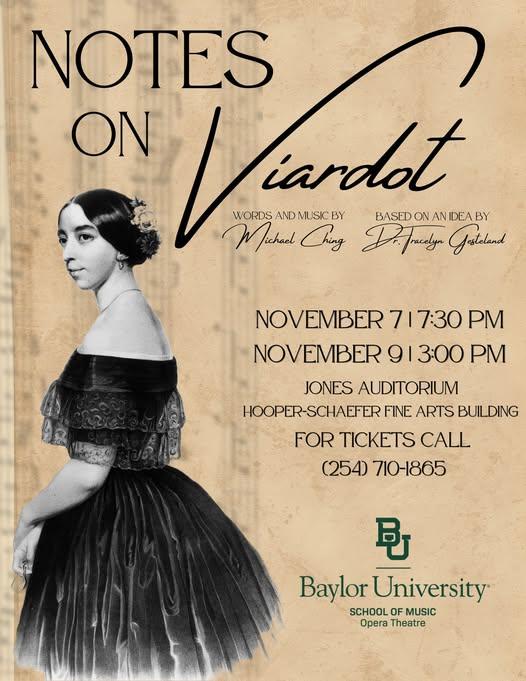
Blending wit, beauty, and historical insight, Notes on Viardot traces the life of a trailblazing artist whose voice and vision shaped generations of musicians from Berlioz and Saint-Saëns to Brahms and Debussy. Ching’s score intertwines Viardot’s own compositions with her legendary roles, creating an unforgettable theatrical experience where the past and present meet on stage.
In her companion article, Kathleen Kelly invites readers into Viardot’s world—unearthing the genius, resilience, and strength of a woman whose music reshaped what artistry could mean.
“The world has finally found a woman composer of genius” - Franz Liszt on Pauline Viardot
I learned about Franz Liszt in music school. As an aspiring pianist, I took on one of his virtuosic compositions, and while struggling to master it I devoured the story of his life. His early talent found financial support and social connection through the Hungarian prince for whom his father labored. A child prodigy, he was connected with the most important artists from his earliest days; there is a story of Beethoven kissing the eleven-year-old Liszt’s forehead on the occasion of the young boy’s debut recital in Vienna, a kind of benediction. Conquering Europe as a touring soloist, composing his own music, championing and connecting myriad artists, he was a nodal point in the nineteenth century musical scene, an all-around artist, a personality. Unforgettable.
In 1832, Liszt taught another eleven-year-old prodigy, Pauline Viardot. Like him, she came from an artistically connected family; her father, sister, and brother were international opera stars. Like him, recognized as a child prodigy, she eventually switched from piano to singing and conquered Europe as a touring superstar who composed her own music and served as a connection point for countless musicians and writers. Like him, she reached a pinnacle of artistic success, adulation, and influence.
But Pauline Viardot, the sovereign singer who played the piano with equal skill, spoke five languages fluently, and collaborated with every prominent composer of three generations; the mother whose long happy marriage existed alongside an equally long relationship with another man; the important teacher who composed songs, piano pieces, and operas; in short, one of the most influential artists of the nineteenth century, did not merit so much as a mention during my musical education back in the 1980s.
Did we forget her? She was never a secret. Critical praise of her composition began as early as 1843, when she was in her early twenties, just a few short years after she blew everyone away with her operatic debut at the age of eighteen. She played piano duets with Chopin. The great virtuoso Clara Schumann said Viardot was the most intelligent woman she had ever met. Meyerbeer, Robert Schumann, Brahms, Massenet, and Saint-Saens dedicated compositions to her, wrote them for her, or asked her to premiere them. She met Rossini when she was a child and Debussy when she was elderly. She was never lost to history, but she did fall away from its front pages. That such a woman could fade from our collective memory at all seems almost impossible.
The stories we tell matter. It matters even more which ones we choose to share, repeat, and remember. I think about this every day in rehearsal, where Baylor Opera Theater is preparing for performances of Notes on Viardot by American composer Michael Ching. Musically, it’s a romp, seamlessly combining the composer’s own contemporary musical style with quotes from Viardot’s own compositions and the opera roles that made her famous. Pedagogically, it’s a dream, a canny play list of iconic nineteenth century vocal repertoire. Theatrically, it’s a thrill, challenging an ensemble cast with constant shifts between roles, locations, and eras. Full stop, it’s good storytelling.
But Ching has done something more than set Viardot’s Wikipedia page to music. He connects Pauline Viardot to us, a room full of Baylor students and faculty, as a fellow artist. When opera-Pauline learns that the drudgery of practice leads to transcendent music-making, we in BOT understand it deep down in our bones because we live that every day. When opera-Pauline finds the joy of embodying new music, or is moved to love through a shared response to great art, or is humble with gratitude toward the people who support her, she is one of us - we feel the magic of familiar kinship with a phenomenal artist of the past, and we’re inspired by another link in the great unbroken chain of musical connection.
Icing on the cake: Notes on Viardot is full of roles for women. You might picture a woman when you think “opera singer” (thanks, Maria Callas), but fun fact: opera roles for men outnumber those for women by about two to one. As I listen to the voices of BOT students ring out in portrayal of Pauline Viardot, her sister Maria Malibran, her friend George Sand, or the young female reporter trying to get a scoop on the diva’s love life, I can’t help but smile at the story behind the story that Ching tells with this opera as he recenters the dimmed voice of a powerhouse by literally lifting up the voices of women.
This is a story we’re glad to tell. It matters. We hope you’ll repeat it and remember.
By Kathleen Kelly, Assistant Professor of Vocal Coaching, Baylor Opera Theatre Music Faculty & Division Director