

British Gospel TV in the 80s
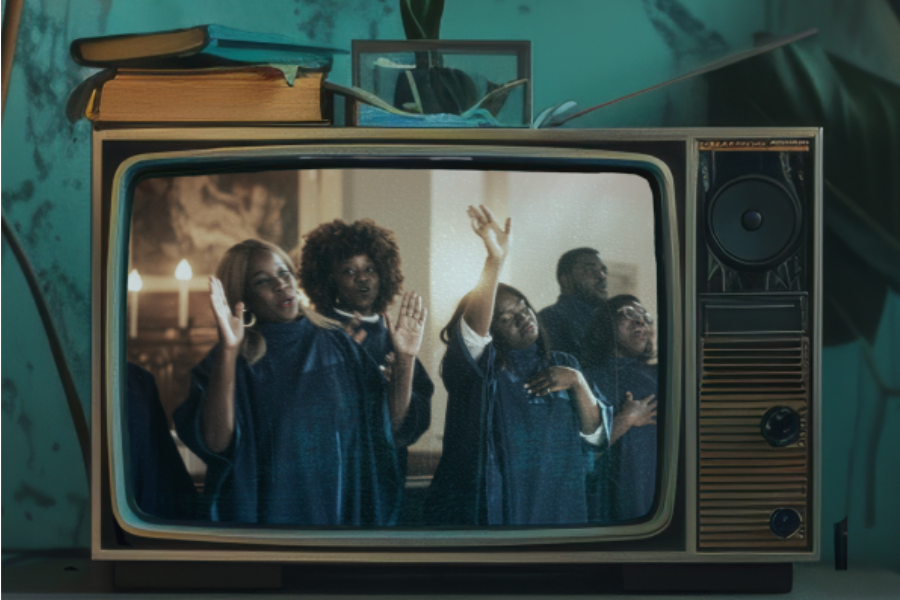
Ever heard of British Gospel Music? It’s more interesting than you may think.
What do you get when you combine the soaring harmonies of Black church choirs, the rich cultural legacy of the African diaspora and the distinctive soundscape of 20th- and 21st-century Britain? British gospel music deserves more attention than it usually receives, especially with its powerful, vibrant and deeply moving musical tradition.
Most people associate gospel music with the American South, and for good reason. Rooted in African American religious life, gospel music emerged from spirituals, hymns and blues traditions in the early 20th century. It was carried forward by legendary artists like Mahalia Jackson and Edwin Hawkins. But gospel didn’t stay in the U.S; it traveled far and wide. And one of the places it has taken deepest root is in Britain.
In the mid-20th century, waves of Caribbean immigrants arrived in the U.K., bringing not only faith and family but also the sounds of their churches: soulful harmonies, rhythmic energy, and a style of worship that emphasized participation,
expression and joy. Touring gospel musicians from the U.S., like Rosetta Tharpe and Andrae Crouch, added to British Black Majority Churches’ songs, as did gospel recordings on radio, film and television. Over time, these influences
were incorporated into the sound of British gospel music.
Today, gospel choirs are thriving across the U.K. — from London to Edinburgh, from Birmingham to Belfast. And, perhaps most surprisingly, they’re not primarily found in churches. Instead, you’ll discover gospel choirs rehearsing in community centers, schools, universities, and performing in concert halls and at national events. The London-based Kingdom Choir, for example, became an international sensation when they sang “Stand By Me” at the Royal Wedding of Prince Harry and Meghan Markle in 2018. Their standout performance, broadcast to over two billion viewers worldwide, brought British
gospel music into the global spotlight.
But what makes British gospel choirs so interesting isn’t just their sound — it’s the way they bring people together. Over the past few years, I’ve attended gospel choir concerts in places across Britain, from large cities like London, Liverpool and Cardiff, to smaller towns. At every stop, I’ve seen something remarkable: singers and audiences that cut across boundaries of race, class, age and belief. One night, I spoke with two white Welsh women who had traveled to the Mississippi Delta in search of “authentic gospel,” and yet were convinced that what they were hearing in Cardiff was just as powerful. At a gospel choir concert in London’s famed Royal Albert Hall, a Black British mother told me she brought her young daughter so she could witness something her grandparents never dreamed possible: a gospel choir performing on the national stage.
British gospel choir performances mean different things to different people. Some audience members respond as if they’re in church — raising their hands, singing along, even crying. Others attend simply out of curiosity or love for the music. Some hear gospel as a call to worship; others hear it as a call to joy, or to justice, or simply to connection. That flexibility — the ability of gospel music to meet people where they are — is part of what makes it such an effective tool for bringing people together across their differences, creating shared experiences through music.
Even among British choir directors and performers, the definition and meaning of gospel music are debated. Over the past six years, I’ve interviewed more than three dozen British gospel choir directors. Their answers to the question “What is gospel music?” are rarely the same. Some see gospel as rooted in its Christian message; others emphasize its African diasporic heritage. Some celebrate the Kingdom Choir’s Royal Wedding performance as a national milestone; others criticize it for performing a secular song and catering too much to British elite sensibilities. Some describe their concerts as spiritual ministry, complete with altar calls and prayer time. Others focus on cultivating musical excellence or broad appeal.
But that’s precisely what makes British gospel music — and gospel music more generally — so fascinating. It refuses to be pinned down. It’s simultaneously religious and cultural, local and global, familiar and surprising. In Britain, it draws on African and Caribbean musical traditions but reinvents them in each new setting and with each successive generation. It’s a music of migration, adaptation and community.
And perhaps most importantly, it’s music that invites participation. Even if you’ve never sung in a choir, even if you don’t know the words, gospel inspires audiences to move, to clap, to sing along. It’s a music that welcomes you in. That’s something rare and beautiful in our sometimes divided world, and something that British gospel choirs offer with open arms and open hearts.
So the next time you hear a gospel choir — whether in person, online or on TV — listen closely. You’re not just hearing great music. You’re witnessing a living, breathing tradition that brings people together, tells complex stories, and makes space for joy, lament, and hope. That’s something worth studying and celebrating.
Monique Ingalls is chair of the School of Music’s Academic and Professional Studies Department; Ammann Chair in Church Music and Worship; and associate professor of Music. Ingalls joined the Baylor church music faculty in 2014. Prior to her appointment at Baylor, she spent three years as a postdoctoral teaching fellow at the University of Cambridge.